

Token number 1644700
“Yes!” I said, standing up from my chair.
“Mrs. Resham Sahini, you are next in turn to meet the doctor” the nurse replied.
I sat back down for a brief moment, reflecting on my ongoing cancer treatment. I felt entirely broken from within, exhausted by the endless side effects. It felt like a journey with no end in sight.
A few moments later, I was sitting in front of the doctor with my latest reports. She looked at me and said politely, “The cancer is beyond treatment now. You have only a few months left.”
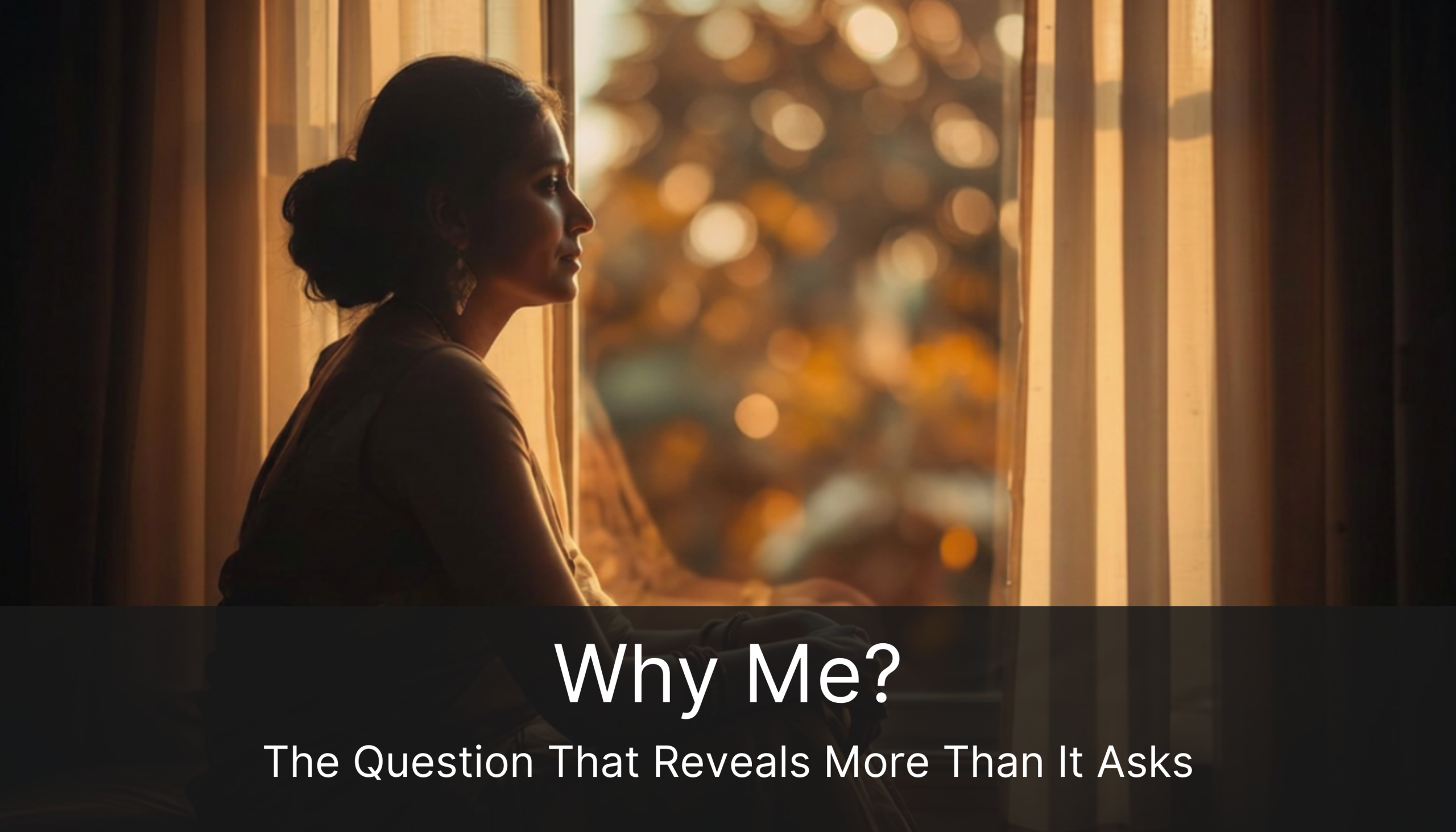
Tears rolled down my cheeks as I asked the doctor, “Why me? I have never touched alcohol, cigarettes, or tobacco. I have lived a disciplined life, exercised regularly, and maintained a healthy diet. How could I get cancer? Why me?”
The oncologist answered with complete silence.
My husband gently led me out of the doctor’s clinic. After a few days, I was admitted into a palliative care centre. On multiple occasions, I wondered if this was the karma of my past life, or perhaps a cosmic debt belonging to a family member that I was to repay. I even questioned if I had unknowingly wronged someone in my present life, for which I’m being punished. I have questioned myself and everyone around me, centenary times, Why Me? And yet, as I near the end of my life, the only question that matters is still unanswered.
When we read the newspaper, or hear about a diagnosis, our brain processes it as data applicable only to a ‘third party’. Illness, tragedy, death — they exist in our minds as things that happen, just never to us. It’s our survival mechanism that keeps the tragedy for others to keep us going. We subconsciously decide that chronic illness like cancer is reserved for the unfortunate ones. We are always the witness, never the subject.
And when suddenly we become the subject — the wall breaks. The question “Why me?” is really asking “Have I done something wrong to deserve this? “. The mind starts to find error in its system because it feels like a personal betrayal.
When cancer strikes, that entire protective scaffolding collapses in an instant. The wall between “the unfortunate third party” and “myself” vanishes. The transition from illusion of being unique to the raw reality of being the unfortunate one is perhaps the heaviest emotional weight a patient can carry.
Yes, “Why me?” is grief, where the patient is angry and feels that the situation is unfair. But underneath it is also the collapse of a very deep, very private self-love and the illusion of personal immunity we’ve been living with ourselves all along.
“Why me?” is also the mind’s desperate search for any cause, because randomness feels crueler than punishment. As humans, we tolerate suffering far better when there’s a reason. And cancer, we know, is random.
When medical science runs out of answers, the human psyche desperately searches for reasons—turning to ideas like karma, past actions, or cosmic debts, just to make sense. We unconsciously feel that good people, careful people, our kind of people — deserve protection. Cancer shatters that unspoken contract. “Why me?” is also asking “What rule of the universe did I break?”
But please hear this: This is not your fault. It is not a punishment, not a reflection of your past deeds, and not a debt you or your family owe to the universe. Cancer is a chaotic, biological error. Unlike an external threat, like a car accident or a natural disaster, cancer comes from inside the body. It is your own cells multiplying incorrectly. It can happen to anyone, completely independent of how wonderfully you lived your life.
The question “Why me?” is heavy and a painful phase. Sometimes, the only way to find a respite toward the end is to gently let go of searching for the cause of the illness, and instead focus entirely on the little joys of the present moment. If you don’t know the answer, probably there isn’t one.
Here’s when the shift in perspective begins. When we shift the question from why is it happening to me to what is it trying to teach me? The patient is still asking. Still searching. But now they’re searching forward instead of backward.
The Universe may not give us a reason, but it does give us a choice.
What if this was your story, will you stay in the question of “Why me?” or will you find the courage to ask “What now?”
Author
Shilpi Agrawal, Volunteer at BHT – Karunashraya
Priya P Nair, PR Manager at BHT- Karunashraya